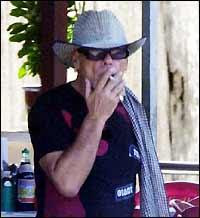
Damn this economy. No one is safe

I think Cheney is crying in his hospital room.
...
Note: Headline links to source.
Labels: Cheney, Darth Vader, economy
Rojak posts, mostly political.
"A writer is a person for whom writing is more difficult than it is for other people." -- Thomas Mann
If so, I must be a writer.

Labels: Cheney, Darth Vader, economy

During an economic speech today, President Bush partly blamed a dramatic rise in unemployment on new workers entering the workforce. Later, in a CNN interview, Bush Labor Secretary Elaine Chao also said that the increase the unemployment rate was "caused in part by a surge of young entrants into the job market."
Labels: economy

I know, I know, oil prices are stratospheric (new high today of $136 per barrel as I write this) and it’s hard to see how it will go back down with increased worldwide demand and finite supply, but just read what Richard Rainwater has to say about the oil bubble about to burst.Who’s Richard Rainwater and why you should listen to him? It’s all explained in this article about Justin Fox for TIME magazine:
Eleven years ago, after doing a lot of studying and a lot of thinking, Richard Rainwater convinced himself that the long decline in oil prices that had begun in the early 1980s was about to end. As a billionaire who had made his name and fortune steering the Texas oil riches of Fort Worth’s Bass family into lucrative nonenergy investments like Disney stock, Rainwater had the wherewithal to act on his conviction. So he plunked down about $300 million of his own money on energy-company stocks and oil and gas futures.
For a while it looked like a boneheaded move. At the end of 1998, the price of oil fell below $10 per bbl. Regular gas sold for 90¢ a gal. While Internet billionaires were being minted to the right and left of him, Rainwater was getting poorer by the day.
You can guess the rest of the story. The dotcoms imploded; the price of oil climbed, climbed and climbed some more–and Rainwater’s energy bet came to look like one of the better investment calls of our time. It has netted him about $2 billion, vaulting him from the mid-200s on Forbes magazine’s 1999 list of the 400 richest Americans to No. 91 last summer (with $3.5 billion overall).
So guess what Rainwater did a few weeks ago, right after oil prices topped $129 per bbl. for the first time? "I sold my Chevron," he says. "I sold my ConocoPhillips. I sold my Statoil. I sold my ENSCO. I sold my Pioneer Natural Resources. I sold everything."
Labels: economy

Continental Airlines Inc said on Thursday it would cut 3,000 jobs, or about 6.5 percent of its work force, and retire 67 older planes as it scales down in the face of soaring fuel prices. The No. 4 carrier is the latest of the major U.S. airlines to announce large cutbacks as they grapple with unprecedented oil prices, which have doubled in the past year.
Labels: economy

The good news is that current homebuyers have the ability to strengthen our long-term economy and protect themselves by following sound financial principles. Foremost among these is living within one's means. This pertains to items small and big, from the food a person purchases to the home a couple buys. [emphasis mine]
Labels: economy

George Soros, 'the man who broke the Bank of England', tells Edmund Conway of his fears for the economy
'This is a period of wealth destruction. The people who make money will be few and far between. There will be a lot more money lost than made." When George Soros - the phenomenally successful hedge fund manager - says this, you know something is wrong, very wrong. And indeed it is. The 77-year-old billionaire sinks back into the sofa in his Chelsea townhouse and exhales.
He has managed to make money almost consistently for over half a century - from his early days as one of the world's first major hedge fund traders to his involvement in Black Wednesday as the man who "broke the Bank of England", and in the latter years generating multi-billion-dollar annual profits throughout the 1990s. The conditions today are almost uniquely dismal, however.
"I think this is probably more serious than anything in our lifetime," he says. In short, his feeling is that the United States and Britain are facing a recession of a scale greater than the early-1990s, greater even than the 1970s.
"I think the dislocations will be greater because you also have the implications of the house price decline, which you didn't have in the 1970s - so you had stagflation and transfer of purchasing power to the oil producing countries, but here you also have the housing crisis in addition to that."
# The financial crisis in full
Such apocalypticisms would be less worrying were it not that Soros was among the few prominent experts who warned of the dire consequences facing the American economy years ago, when the housing bubble was still inflating.
But even cottoning on to the big economic story early on hasn't meant guaranteed success. He returned from retirement last summer, and no sooner had he started trading than he pulled hundreds of millions of dollars of investment out of the US and the UK. It was enough to help him to a 32pc return last year. But amid the turbulence of 2008, he admits he is barely breaking even.
Labels: economy, George Soros

Businesses have scored a legislative victory in South Carolina that could make it easier to develop construction projects without waiting for a final decision on state environmental permits.
The House approved a measure Thursday giving environmentalists, citizens groups and developers only three days to prepare for hearings on whether projects can be built before administrative courts resolve permit disputes. That's down from 10 days.
In addition to the time limit for a hearing, environmental groups say the bill also prevents what is known as an automatic stay on some projects if a developer has obtained many of the permits.
Environmentalists believe the changes make it more difficult to ensure that projects aren't built before permit disputes are resolved. If a project is built and the developer later loses his permit case in court, it will be difficult to force a construction project to be torn down or scaled back, they say.
A proposal to strip-mine for phosphate in more than 4,000 acres of wetlands near the Pamlico River in North Carolina was outlined Friday by the Army Corps of Engineers in an environmental impact statement.
If the plan is approved after a public comment period, it would result in the largest permitted wetlands destruction in the state's history.
PCS Ohosphate, the company seeking approval, wants to extract phosphate for the next 37 years from three separate tracts of land near its existing mine in Aurora. The mining operations would span more than 15,100 acres, including 4,135 acres of water and wetlands. The company expects to spend $4.76 billion over the decades-long expansion plan.
The last time the corps allowed a company to venture into such a large amount of wetlands was in 1997 when PCS Phosphate received certification to begin mining 1,263 acres of wetland on its current operations.
One of Britain's largest estate agents has fallen victim to the slowdown in the housing market, prompting fears for thousands of jobs around the country. Shares trading was suspended in Humberts, which has 80 branches from Central London to Hampshire, amid doubts about its viability. The group's demise would be the first high-profile estate agency casualty of the housing market squeeze.
Labels: economy

Danielle Brown stands outside a South Side market at midnight, braving the spring chill for her first chance to buy groceries since her food stamps ran out nearly two weeks ago.
...
This is what the skyrocketing cost of food looks like at street level: Poor people whose food stamps don't buy as much as they once did rushing into a store in the dead of night, filling shopping carts with cereal, eggs and milk so their kids can wake up on the first day of the month to a decent meal.
"People with incomes below the poverty threshold are in dire straits because not only are food prices increasing but the food stamps they are receiving have not increased," said Dr. John Cook, an associate professor at Boston University's medical school who has studied the food stamp program, particularly how it affects children.
On the South Side of Chicago, people like Brown wait for the stroke of midnight, when one month gives way to another and brings a new allotment of food stamps.
Dennis Kladis began opening his family owned One Stop Food & Liquors once a month at midnight nine months ago to give desperate families a chance to buy food as soon as possible.
"I'm telling you, by the end of the month they're just dying to get back to the first," said Kladis, who has watched other area stores follow his lead. "Obviously, they are struggling to get through the month."
Jean Daniel, a spokeswoman for the Agriculture Department, which runs the food stamp program, said there is only so much the aid can do.
"Food stamps were designed to be a supplement to the food budget," she said. They "were never intended to be the entire budget."
Labels: economy
The US Federal Reserve today led another intervention to ease global liquidity by joining the European Central Bank (ECB) and the Swiss National Bank (SNB) in efforts to flood the Continent with dollars while pumping a further $50 billion (£25.3 billion) into the American financial system.
Labels: economy

Surging prices for copper, zinc and nickel have some in the U.S. Congress advocating the steel-made pennies of World War II because it costs more than a penny to make one and a nickel costs 7.7 cents.
Labels: economy
Labels: economy

And you thought that I had a gloomy outlook on the economy. Now the bad news pops up everywhere.
Harry Koza in the Globe and Mail quotes Bernard Connelly, the global strategist at Banque AIG in London, who claims that the likelihood of a Great Depression is growing by the day.
Martin Wolf, celebrated columnist of the U.K.-based Financial Times, cites Dr. Nouriel Roubini of the New York University's Stern School of Business, who, in 12 steps, outlines how the losses of the American financial system will grow to more than $1 trillion - that's one million times $1 million. That amount is equal to all the assets of all American banks.
Every day now, thousands of people all over the U.S. and Great Britain are walking away from their homes - simply mailing their house keys to the banks - as housing bailout plans fail.
With unemployment growing, the next phase will hit commercial real estate making the financial institutions the unwilling owners not only of quickly depreciating houses, but also of empty strip malls and even larger shopping centres.
The next domino to fall will be credit card defaults, and after that... who knows? There are so many exotic funds out there, with trillions of dollars in paper - or rather computer-screen money - all carrying assorted acronyms, and all about to disintegrate into nothingness. Over the next couple of years, scores of banks that have thrived on these devices, based on quickly disappearing equities, will fail.
The most frightening forecast so far comes from the Global Europe Anticipation Bulletin (GEAB), available for 200 euros - about $300 - for 16 issues annually. Its prediction is quite specific.
Where my warnings never spelled out an exact date, this think tank has it pegged precisely. Here are its very words:
"The end of the third quarter of 2008 (thus late September, a mere seven months from now) will be marked by a new tipping point in the unfolding of the global systemic crisis.
"At that time indeed, the cumulated impact of the various sequences of the crisis will reach its maximum strength and affect decisively the very heart of the systems concerned, on the front line of which (is) the United States, epicentre of the current crisis.
"In the United States, this new tipping point will translate into - get this - a collapse of the real economy, (the) final socio-economic stage of the serial bursting of the housing and financial bubbles and of the pursuance of the U.S. dollar fall. The collapse of U.S. real economy means the virtual freeze of the American economic machinery: private and public bankruptcies in large numbers, companies and public services closing down."
The report goes on to say that we are entering a period for which there is no historic precedent. Any comparisons with previous situations in our modern economy are invalid.
We are not experiencing a "remake" of the 1929 crisis nor a repetition of the 1970s oil crises or 1987 stock market crisis.
What we will have, instead, is truly a global momentous threat - a true turning point affecting the entire planet and questioning the very foundations of the international system upon which the world was organized in the last decades.
The report emphasizes that it is, first and foremost, in the United States where this historic happening is taking an unprecedented shape (the authors call it "Very Great U.S. Depression").
It continues to predict that, although this crucial event is global, it will be the beginning of an economic 'decoupling' between the U.S. and the rest of the world. However, non 'decoupled' economies will be dragged down the U.S. negative spiral.


Labels: economy

American as well as all western white and blue collar workers will soon realize that they will either have to decrease their wage demands to conform with "global standards" or chose jobs in the service sector. These global standard wages are now being set by worker in India and China, where average hourly wages are about 65 cents and one dollar respectively. The high paying jobs created in Mexico under NAFTA, the whopping $3.50 per hour ones, are moving to China because even this princely wage level is much too generous according to U.S. businessmen.
Labels: economy

With the economy in a nosedive, Americans are shedding unnecessary expenses, saving their cash and voting "no" to discretionary spending. That means later for lattes, farewell to fashion and goodbye to family vacations at Disney World.

Labels: economy

For a bipartisan majority of senators, providing three months or six months of extra unemployment checks to more than 1 million jobless people is a better way to dig the economy out of a recession than just printing tax rebate checks.
Some economists agree, and undoubtedly, so do the nearly 1.3 million unemployed workers who face losing an average $282 a week in benefits before June.
But there is strong opposition leading up to a Senate vote in the week ahead on whether to add an extension of jobless benefits to a $161 billion House-passed combination of tax rebates and business tax cuts.

Labels: economy

Labels: economy

The United States is sliding towards a dangerous 1930s-style "liquidity trap" that cannot easily be stopped by drastic cuts in interest rates, Nobel economist Joseph Stiglitz has warned.
Labels: economy

Ford Motor Co. said Thursday it will offer buyout and early retirement packages to all 54,000 U.S. hourly workers in an effort to cut more jobs and replace workers with those making a lower wage.
Chief Executive Alan Mulally said the new round of buyouts was negotiated with the United Auto Workers union.
Labels: economy

With the economy's prospects growing bleaker seemingly by the day, politicians in both parties have rallied around the three Ts, the mantra that any stimulus package needs to be timely, targeted and temporary [emphasis mine].
Labels: economy